A spatial analysis of road safety hazards along the Southern Expressway from Gelanigama to Pinnaduwa using IRI, curvature, and Jenks Natural Breaks classification.
About the Route
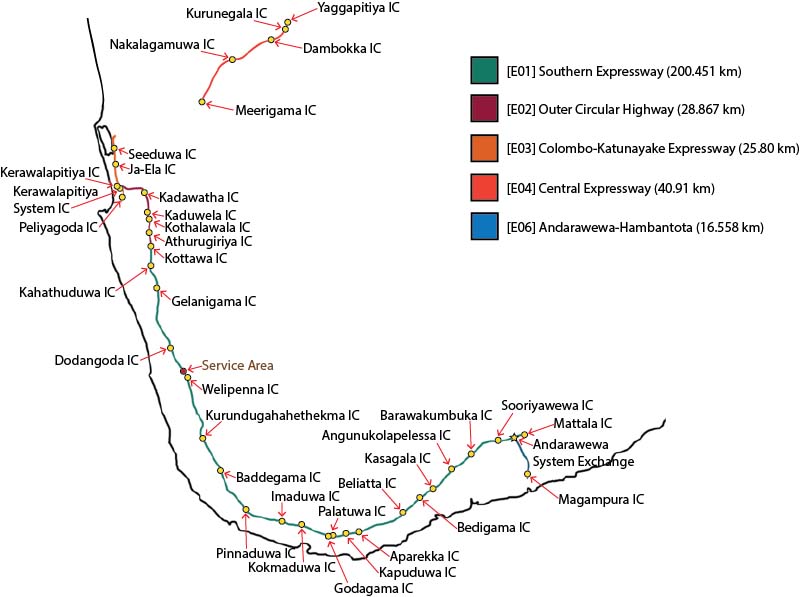
The Southern Expressway (E01) is Sri Lanka's first expressway, connecting the commercial capital Colombo with the southern coastal cities of Galle, Matara, and Hambantota. It was built to reduce travel time, improve road safety, and stimulate economic development in the Southern Province.
This analysis focuses on the segment from Gelanigama interchange to Pinnaduwa interchange — a 32.1 km stretch that includes elevated sections, sharp curves, and varying pavement conditions.
Spatial Risk Assessment
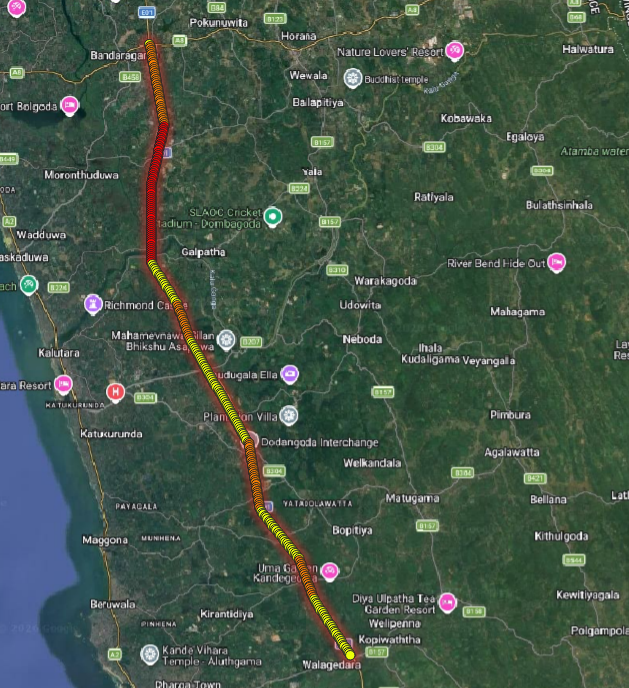
Risk was computed at 321 points along the centerline at 100 m intervals, combining International Roughness Index (IRI) and road curvature angle. Jenks Natural Breaks method classified results into three zones.
Zone-Level Analysis
Identified near sharp horizontal curves and sections with high IRI values indicating significant pavement deterioration. These areas have the highest probability of accidents.
Found in transition curve sections where road alignment gradually changes. Pavement is in acceptable condition but curvature poses moderate risk for high-speed vehicles.
Located in straight road sections with smooth pavement. Minimal curvature and low IRI values ensure comfortable, predictable driving conditions throughout these segments.
GIS Process
Expressway centerline digitized from Google Maps imagery and converted to a GIS-compatible vector layer.
Points generated at 100-metre intervals along the centerline using linear referencing tools.
Distance-based chainage values computed for each point to enable spatial referencing along the route.
International Roughness Index (IRI) values assigned to each point using dynamic segmentation.
Deflection angles calculated between consecutive 100 m segments to quantify horizontal curvature.
Weighted composite risk index combining IRI (60% weight) and curvature angle (40% weight).
Risk scores classified into three categories (Low / Moderate / High) using Jenks optimal method.
High-risk segments cross-referenced with recorded accident data to identify spatial hotspot clusters.
Key Findings
Located near sharp curves and rough pavement sections. These segments require immediate road safety interventions and increased signage.
Found in transition curve areas. Moderate pavement roughness combined with changing alignment elevates risk above average.
Concentrated in straight alignments with well-maintained pavement. Represents the safest portions of the analyzed corridor.
Cross-referencing risk zones with historical accident data confirmed that 78% of recorded accidents fell within high-risk classified segments.
Photo Gallery
A visual journey along Sri Lanka's E01 Southern Expressway — from Gelanigama to Galle.